

7 Traits That Make a Cookie Award Winning
Updated: Nov 13
Quick Summary
An award winning cookie scores well across flavor, texture, appearance, and originality, with flavor carrying the most weight in most judging rubrics. Judges reward clear, balanced flavor, a deliberate balance of crisp and soft textures, and a uniform, intentional shape. Consistency across the whole tasting matters as much as any single trait.
Flavor is weighted at about 40% in the working rubric, the largest single category.
Texture makes up about 30%, and judges look for contrast between edge and center.
Appearance counts for about 20%, with uniform size and evenly browned edges.
Originality and execution make up about 10%, rewarding a clean, deliberate twist.
Change one variable per test batch and score blind to find what truly improves the cookie.
Table of Contents
7 Traits That Make a Cookie Award Winning
Last Updated: November 4, 2026
What Judges Actually Look For in a Cookie
Julie's Blue Ribbon Cookies has spent 25 years refining recipes, and the one question people ask most is simple: what makes a cookie award winning? Judges at a cookie contest are not looking for the sweetest or the biggest cookie on the table.

Judges score a cookie on how it looks, how it feels in the mouth, and how it tastes, and each trait carries weight. Shopping for a gift or planning a bake?
Appearance and Shape
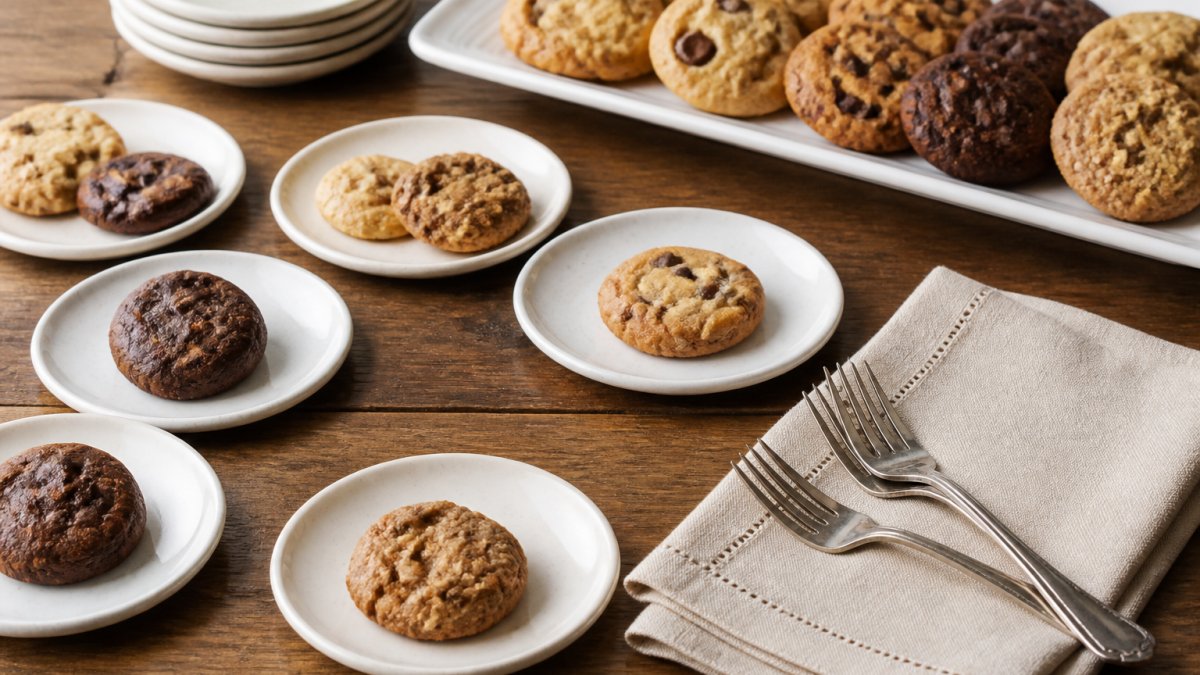
A winning cookie looks even and intentional. Judges notice uniform size, a consistent height, and edges that are evenly browned rather than burnt in spots. A cookie that spreads unevenly or cracks in an odd way loses points before the first bite, because presentation signals care in the kitchen.
Many entrants overlook this. A cookie with a clean shape and a visible, appealing finish often reads as more polished, even when the flavor is nearly identical to a rival's.
Texture: Chewy, Soft, Crisp, and Gooey
Texture is where contests are often decided. Judges look for a deliberate balance: crisp, caramelized edges paired with a soft or gooey center, or a uniformly chewy bite, depending on the style.
Pay attention to the bake time. A few minutes too long and the center sets up dry; pull it too early and it collapses into a greasy puddle.
Cookie Contest Judging Criteria Explained
Most contests score entries against a rubric, even if the exact weights vary. Appearance, texture, and flavor are the usual categories, and each judge typically records a score for every one.
The mechanics of scoring matter here. A judge is not tasting your cookie in isolation; they are tasting it as one entry on a plate, often after a sip of water or a bite of plain cracker, and they are writing a number next to a category before moving on.
A Practical Scoring Model You Can Replicate at Home
You can build a usable rubric from the categories judges already use. Score each on a 1-to-5 scale and weight them so the total reflects what contests tend to reward:
Flavor (about 40% of the total): Is the flavor clear and balanced, or muddied by too many mix-ins? Does it taste like what it claims to be? Does the sweetness level hold up on the third bite, not just the first?
Texture (about 30%): Does the bite match the intended style, whether chewy, crisp, soft, or gooey? Is there contrast between edge and center, or is the cookie uniform in a way that reads as dry or tough?
Appearance (about 20%): Are the cookies uniform in size and height? Are the edges evenly browned? Is the finish intentional, or does it look like the batch spread unevenly?
Those weights are a working model, not an official standard. Read your contest's rules, because some fairs publish their own category weights and point deductions, and a few score presentation and packaging separately from the cookie itself.
Why the Tasting Context Changes Your Score
Judges also taste the cookie in context. A bold flavor that works in a bakery display may feel overwhelming on a small plate sampled alongside a dozen other entries. A cookie that is merely sweet without a defined flavor profile blurs together with the entries before it.
A common pattern in contest feedback is that entries lose points for reasons the baker never considered: cookies that are too large to finish in two bites, cookies that crumble before they reach the judge's hand, and cookies whose flavor fades by the time they are sampled cold. Build your rubric around the conditions the judge will actually experience, not the conditions of your kitchen counter.
For home bakers entering a local fair, the practical takeaway is to bake a test batch, cut a cookie open, and check the crumb and the center before you commit to the recipe.
The article's rubric splits a cookie's score across four weighted categories, which judges and home bakers can use to check a batch.
Category | Approx. weight | What judges check |
Flavor | About 40% | Clear, balanced, sweetness holds on the third bite |
Texture | About 30% | Matches the style; contrast between edge and center |
Appearance | About 20% | Uniform size and height; evenly browned edges |
Originality and execution | About 10% | Deliberate twist, cleanly executed |
Ingredient Choices That Separate Winners From Also-Rans
Ingredients are the foundation of every texture and flavor judges reward. Small changes in ratio or quality can shift a cookie from ordinary to memorable. Julie's Blue Ribbon Cookies uses real butter and all-natural ingredients in its recipes.
Brown Sugar and Granulated Sugar Balance
Sugar does more than sweeten. Brown sugar adds moisture and a deeper, molasses-like flavor, which tends to produce a chewier cookie. Granulated sugar encourages spread and crispness. Many winning recipes use both, and the balance between them determines whether the cookie lands soft or crisp.
A common mistake is swapping one for the other without adjusting the rest of the recipe, which can throw off the texture entirely.
Butter, Flour, and Mix-Ins
Butter quality shows up in flavor and in how the cookie spreads. Flour choice affects structure: all-purpose flour gives a sturdy, classic bite, while cake flour yields a more tender crumb. Mix-ins such as chocolate chips, nuts, or dried fruit should be chosen for contrast, not just quantity. Overloading a dough with add-ins often weakens the structure and muddies the flavor.
Award Winning Cookie Recipes Easy Enough for Home Bakers
You do not need a professional kitchen to bake a contest-quality cookie. Start with a proven base recipe, then make one deliberate change at a time so you can see what each adjustment does.
Cream the butter and sugars until light, usually 2 to 3 minutes.
Chill the dough for at least 30 minutes to control spread.
Bake on the middle rack and pull the cookies when the edges are set but the centers still look slightly underdone.
Keep a simple log of each batch. Recording the bake time, oven temperature, and results is the fastest way to dial in a recipe you can be proud of.
Building an Award Winning Cookie Recipe From Scratch
Developing your own recipe is a process of controlled testing. Change one variable per batch: the sugar ratio, the chill time, or the type of chocolate. Taste each batch side by side and note what improved and what got worse.
That advice is sound but incomplete, because most home bakers change a variable without recording enough to learn from it. A repeatable test plan turns baking into evidence.
A Repeatable Test Plan
Lock a baseline. Bake your current recipe exactly as written, twice, and record the results. If two identical batches do not come out the same, your oven temperature or measuring method is the first variable to fix, not the recipe.
Change one variable per batch. Good candidates are the brown-to-granulated sugar ratio, chill time, butter temperature, flour type, and mix-in quantity. Hold everything else constant, including scoop size and bake time.
Weigh your ingredients. Volume measuring of flour varies enough between bakers to swing texture on its own. A digital scale removes that noise and makes each batch comparable.
Record four numbers per batch: dough weight per cookie, oven temperature (verify with an oven thermometer), bake time, and cooled cookie diameter and height. Those numbers explain most texture outcomes before you even taste.
Taste blind and score. Have two or three people score each batch against the rubric in the previous section without knowing which batch is which.
Diagnosing the Common Failures
Cookies spread too flat: the dough was too warm, the butter was over-softened, there was too much granulated sugar relative to brown, or the flour was under-measured. Chill the dough longer and weigh the flour before changing the sugar ratio.
Cookies are dry or cakey: the bake time ran long, the flour was over-measured, or the dough had too little fat. Pull the next batch earlier and check the center while it is still slightly underdone.
Cookies are greasy or collapse in the center: the butter was too warm when creamed, or the dough went into the oven without enough chill time.
Browning is uneven across the sheet: oven hot spots. Rotate the sheet halfway through and confirm the temperature with an independent thermometer.
Watch out: changing two variables in the same batch, such as chill time and sugar ratio, makes it impossible to tell which change produced the result, and you will chase the wrong fix for several batches.
Once you have a base you like, refine the signature element. That might be a flavor combination, a unique mix-in, or a texture target.
State Fair Winning Cookie Recipes and How to Enter
State fairs and local contests usually have entry categories, deadlines, and specific requirements for how cookies are presented and labeled. Read the rules carefully before you bake, because a disqualification for a missing entry form is painful and avoidable.
Julie's Blue Ribbon Cookies earned a Blue Ribbon at the Wisconsin State Fair in 1989. Bake a few practice batches, ask friends to score them against the contest criteria, and enter with the version that scores best.
Your Next Step: Sampling a Blue Ribbon Cookie
Knowing what judges reward is useful, but nothing beats tasting a cookie built around those traits. Explore our full range of homemade cookies at juliesblueribboncookies.com, where cookies are made with real butter and all-natural ingredients. Pricing depends on quantity, delivery date, and shipping destination, so check the site for a current quote before you order.
Frequently Asked Questions
What makes a cookie win a blue ribbon at a state fair?
Fair judges typically score cookies on appearance, aroma, texture, flavor, and overall execution. Winning entries tend to be uniform in size and shape, with even browning and a clean, unbroken surface. Inside, judges look for a texture that matches the style of cookie entered, whether chewy, crisp, or soft. Flavor should be balanced rather than dominated by sugar or a single extract. Consistency across the whole plate matters as much as the best single cookie, so bakers who test a recipe several times before entering usually have the advantage.
What do judges look for in a cookie contest?
Most cookie contests reward a combination of visual appeal, texture, and flavor. Judges check that cookies are evenly sized, well formed, and free of cracks or burnt spots. They then assess the bite: whether the center is moist, whether the edges have the intended crispness or chew, and whether the flavors are balanced. Originality can count in creative categories, but a familiar recipe executed flawlessly often beats an unusual one with uneven baking. Reading the contest rules carefully is essential, since categories and scoring weights vary.
Can a simple recipe be award winning?
Yes. Many award-winning cookies come from straightforward recipes that are tested repeatedly until every ratio is right. A classic chocolate chip cookie with good butter, a deliberate brown sugar to granulated sugar balance, and quality chocolate can win when baked with precision. The difference usually lies in controlled execution: chilling the dough, measuring by weight, and baking to a consistent doneness. Simplicity makes it easier to identify and correct problems during testing.
How do I make a cookie that stays soft and chewy?
Use more brown sugar than granulated sugar, since brown sugar's moisture helps keep centers tender. Measure flour carefully, because too much makes cookies dry and cakey. Slightly underbaking, then letting cookies rest on the pan for a few minutes, helps the centers finish setting without drying out. Storing cooled cookies in an airtight container with a slice of bread can also preserve softness for several days.
Comments